Friday, September 28, 2012

Going hoarse and finding my voice

The dove descending breaks the air
With flame of incandescent terror
Of which the tongues declare
The one discharge from sin and error,
The only hope, or else despair
   Lies in the choice of pyre or pyre--
   To be redeemed from fire by fire.

   Who then devised the torment? Love.
Love is the unfamiliar Name
Behind the hands that wove
The intolerable shirt of flame
Which human power cannot remove.
   We only live, only suspire
   Consumed by either fire or fire.

--T.S. Eliot (from "Little Gidding")*

My dad sent me an email two days ago prompting me to write. Why haven't you written recently on the blog? he asked. Some of my friends in college would write poems every day, it seemed, for every little thing. I don't do that. It takes me a long time to gestate thoughts into language. These days, I'm getting ready to leave Floyd, which has been my home for the last four months and a kind of new birth for me into the world after my own intellectual gestation of the past 16 years of schooling. I'm getting ready to leave and my brain is too crowded to easily sort idea from idea and peck them out into sentences and paragraphs. It's hard for me to write when I'm unsettled. (Consumer warning: Yeah, this post is going to be total naval-gazing. I'm sorry. It's the end of the summer. I promise to post pretty pictures next time.)

Last week, I talked to Betsy for a while about how hard it is living alone. Days pass and I say few words to anyone. I get out of practice having conversations; the sound of my own voice becomes strange. I get used to the little non-causal explosions of thought that erupt in my brain without organizing them into linear thoughts. In the absence of speaking, I feel like I've lost my voice. Writers talk a lot about having a "voice," of course, but that conversation with Betsy was the first time I thought of that abstract writerly "voice" in terms of the experience of speech--the string of words which ties our lives together, individually and corporately. Being by myself this summer and keeping my voice inside my head so much, I feel like my personhood has somehow been sort of diminished. I often find I don't know my own mind before I have a conversation, and in the absence of other minds this summer, I've been at risk of loosing mine.

I have had many wonderful conversations in the fields with my coworkers, I don't want to sound like I've been a complete Cistercian, but there's been a lot of silence--good silence, time to wait for myself to grow up, time to finally take note of the changes within myself particularly during the past four collegiate years which have not allowed much time for contemplation. I've needed that. But I also need community. If you know me at all, you know I'm pretty obnoxiously, neurotically independent and having to be independent this summer has made me realize how much I love other people, how much my personality doesn't exist unless it's in conversation with another.

It's been constantly amazing during this past summer how at peace I feel when I'm with others. After I bought my car, there were a few evenings I drove all the way to Blacksburg (45 minutes) just to sit in the library or Starbucks until they both closed. I'm sure the other patrons would have been completely weirded out if they had known how greedily I listened to their gossip and arguments over physics homework. Back at the farm, solitude in the evenings oscillates between unbearable loneliness and complete contentment. I didn't knew before that it's possible to experience both emotions almost simultaneously. Is that what adulthood is like? Shoot. I didn't sign up for this.

But the summer's over, folks. The calendar has announced and passed the first day of fall and the colors as I drove down Allegany Springs Road for the last time on my way to 81 on up to Marieke and Betsy in the D.C. area. (Fast fact: Northern and southern Virginia are really totally different. Also, I can't drive in traffic or parallel park without almost causing accidents. Don't tell my mom. She'll worry about me.) This week, I helped dig 1,500 lb of sweet potatoes in 4 hours with Nii Anang, I learned how to feel trees, I cut and split 3 cords of wood, and I found two baby possums in my trash wrapped up in greasy plastic (they are totally gross, not cute). We wound up the irrigation hoses and planted winter cover crop and the last of the lettuce. I'm done with Seven Springs Farm and the season is over. It's been so lovely--the people, the land, the work. I can't imagine a better place to have accidentally ended up as a confused college grad. So thanks, Floyd County, VA and all my new friends. It was an honor to have known you.

It's hard to leave and I'm going to miss forgetting when I brushed my teeth last or showered, I'll miss the fresh food which has totally ruined eating out for me. I'll miss talking about farming as a spiritual discipline out in the fields with Polly and learning African folk songs. Having to wear shoes every day is going to suck. But I'm so glad to be with friends again. I'm so glad I'm moving to a place where I'm going to have a wonderful spiritual community. (Warning to all my friends in Dallas: I'm planning on being obnoxiously social. Sorry.) It's nice to use this hoarse voice again.


*(Yeah, so if you're looking for a connection between the "Little Gidding" quote and this post... there's not really one. I just really love that poem. And you thought I'm some kind of deep and obscure English major? Ha.)

Friday, September 7, 2012

Gloves of Manhattan

Here are some pictures of gloves I've seen laying around in the street. My original intent was to make this a Gloves of Harlem feature, but I keep seeing them in Midtown and the Village, so I thought I'd broaden my scope. Also I keep forgetting to note specific addresses, so this isn't very helpful to people missing gloves. But I do what I can.


That one doesn't really look like a glove, but I promise it is. It's one of those plastic foodservice ones. 


This nice pink glove is my favorite of the bunch. I hope its owner can track it down. 


This one was a few blocks from Madison Square Garden, I think. 

The Top of the Blue Ridge

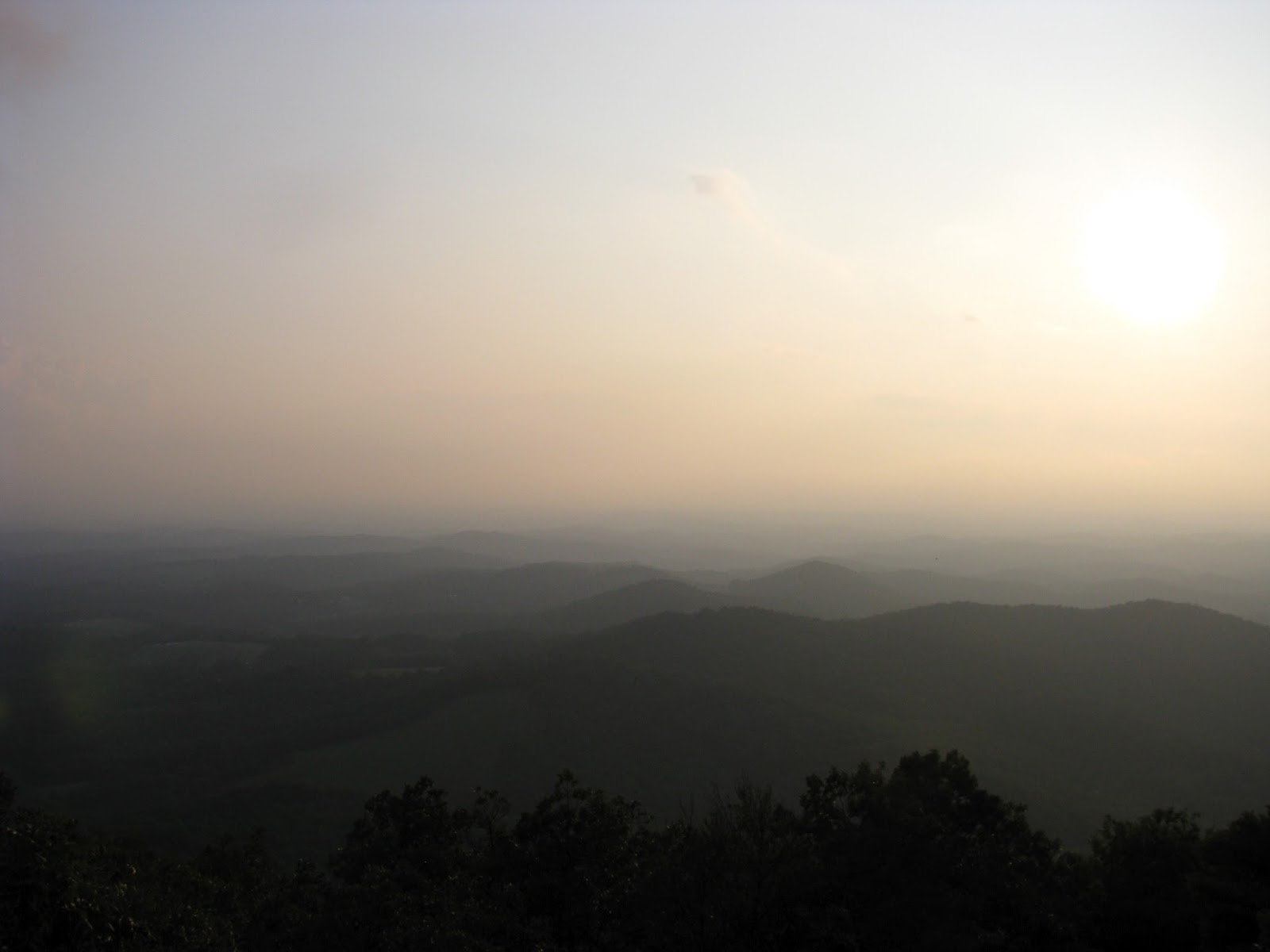
Last Thursday, I took the afternoon off because I had helped Ron build a retaining wall the Saturday before. By "helped build a retaining wall" read "I lugged 80lb blocks of concrete and it was really hot." I sort of got a pretty good idea of what the people who built the pyramids felt like. The plan had been to spend my Thursday in Roanoke, which I haven't explored yet, but I realized that I haven't seen much of Floyd and I figured I should know where I actually live before I go galavanting around. I ended the day with a gorgeous solo hike up to the peak of Buffalo Mountain, and I just want to share some of the pictures with you.

This is possibly the best junk shop ever. No hyperbole. 


Freeze-dried coffee. It's a big deal, folks. 
When I was asking around in Floyd about how to get to the trailhead, they said, "Oh, it's by Daddy Rabbits!" "Um, excuse me?" "You know, Daddy Rabbits." "Someone raises rabbits.... or this is a nickname for some old codger?" "No, no, no, it's a campground." "Gotcha."


I reached the top just before sunset.


Yeah, I live somewhere down there.


Thursday, September 6, 2012

Magnificent Muffins

I like to eat--a lot. Luckily, I like to cook almost as much as I like to eat. This summer has been an unending feast of the freshest produce available, and I've eaten, well, a lot. I told my sister last night that rather than acquiring that lithe athletic figure that I've always sort of vaguely (and vainly) hoped for, I've settled into the strong and comfy build of a porky farm wife. Oh dear. Too much delicious butter, too many eggs, so many helpings of lightly steamed vegetables, venison stews, gigantic salads.... I've reveled in simple foods: beets roasted in olive oil, buckwheat pancakes with honey, squash mush (delicious) for breakfast, big ripe tomatoes eaten like apples, seeds all down the front of my shirt.

I have no regrets. None.

So that you can share in my guiltless glorying in food, I'd like to share what I made tonight--what I'm calling Magnificent Muffins, because I'm in a sportive mood and alliteration if fun. Bonus: these muffins are gluten-free. The precise instructions are courtesy of my scientific cooking methods.

Magnificent Muffins 

Ingredients: 
- A little heap of cornmeal
- A matching mound of buckwheat 
- One small grated zucchini
- Ditto, except a carrot
- Two pinches of salt
- A couple dashes of baking powder (baking soda has aluminum in it, and baking powder is more interesting anyway, because you have to  be clever and think of something yummy and acidic to react it with and get the bubbling action)
- An egg
- A couple sloshes of yogurt for the flavor and to make magic with the baking powder
- Some chopped basil (don't cut yourself like I did while chopping it)
- Some chopped parsley
- A liberal amount of feta cheese 
- Oh, and don't forget a glug of olive oil

 Directions:
Mix everything together with the least amount of care possible, preferably while listening to Fresh Air, and add a little water or milk if the yogurt and egg don't give the mix enough moisture--but they should. Add a splash of cayenne pepper if you're feeling bold, and pour into muffin tins you probably neglect to grease. Bake at some suitable temperature until a fork comes out clean. Pry out of the tins. You may end up with something that looks like a little fluffy mountain, rather than a muffin. If this happens, make a note above your stove remind yourself to grease pans diligently and enjoy the crumbs with a liberal amount of butter. 

Friday, August 31, 2012

Trick chickens and dead chickens

Yesterday, we had to kill one of my chickens.

I had three, all happy in this little wire box called a "chicken tractor" which we'd wheel around the garden to give them new tasty bugs and grass every day. In exchange for this pampering, our gardens eat the nitrogen in their...um...manure.

I had decided from the first day that I was not going to get attached to them: They're chickens. They're egg machines, and, I thought, they will stay egg machines. I am a farm woman; I will not have pet chickens.

So I didn't name them. Other than filling up their water, wheeling them around, and feeding them, I spent no time with them. I was thankful for the egg which would show up every day, but that's as far as my emotional attachment went. I remained cool, aloof.

That is, until the stupid little birds decided they liked me.

The first week, they huddled away from me every time I opened the top trap, making concerned little noises and jumping out of their feathers as bits of feed rattled down. Gradually, however, they got used to me. Even my hat falling in did little to ruffle them. I could practically drop a jar on them and they'd look up with thankful, beady, greedy little eyes. They started making soft cooing noises whenever we'd weed near them, little chickens songs and contented clucks.

The end of my emotional disattachement came, however, when they started coming to me. The backtrap swings open sometimes; the latch isn't too tight and I'm too lazy to fix it. So one or two mornings a week, I walk past or we drive up to pick lettuce, and they're meandering around the bean patch eating beetles. The first few times this happened, I had to chase them a bit. Then they'd let me walk up to them.

Last week they started walking up to me. I didn't even have to train them; take that, Flannery O'Connor. They'd perk up their little heads, see me coming, and one of them would scamper over and squat down so I could pick her up. Another one would pretend to run away from me,  but while I scooped up the third and hopped over the bean rows to their tractor, a chicken under each arm, she's sort of mosey over as if the whole thing were her idea. I imagine she wanted to maintain some pretence of independence--and there I go, anthropomorphizing. But she'd mosey over and sort of scoot away from me as I tried to pick her up. I'd fold my arms and pretend not to care, and she's come back and cluck a bit as I grabbed her between both wings and dump her through the top trap.

But then on Friday one of them, started hunkering down in the corner with her eyes half shut. The side of her neck was plucked and damp. The other chickens never bothered her; she worried herself, plucking feathers and dribbling herself with water. I don't know why or what was wrong.

All I knew was that I couldn't kiill her.

I've been here for 3 months, and though I've helped butcher a couple animals, I've never killed one. I didn't want my "friend-chicken," as Nii'Anang called her, to be the first. Sillier yet, I didn't want the other chickens to know that I was involved in killing their friend, which is probably absurd, but that's how I felt. So I had Nii'Anang slit her throat quietly in the woods. That was yesterday, and by then she had developed a little cough, like pneumonia, and looked terrible. I couldn't look at her when I went to feed them.

I was talking to a friend on the phone the other evening about the joys of farming, and he used the term "man's mastery over nature." Maybe it's because I hang out with feminists, but I winced. Just to prove I'm not a feminist (though I respect them), I corrected him with the term "husbandry."

The truth is, we don't have very much mastery. We have to remove ourselves via technology and urbanization before we can afford that illusion. Heck, I can't even control my own heart when I get all tore up over a little chicken's suffering. Much less can I control the rain, seed germination, and the chicken herself. Some years are good bean years; the next, though, the beans all die. Why? We don't know.

We lost our onion crop to tiny little insects called thrips; everyone was in a black mood for two weeks after that. Deer ate all of our lettuce, and no deer fence seemed able to stop them. That same week, the racoons completely destroyed our corn crop. Yeah, we're organic--but you don't think conventional farmers have the same problem? They can manufactor all the petroleum-based nitrogen they want, but when it doesn't rain, they hurt. We're not in control. We just work with the world, within the world, and we'd best not forget that. We learn some, we cajol things into flourishing, but consider the lilies and the sparrows. We're not too far removed from them, despite the fact we can fly in cucumbers from Mexico or wherever in December.

And then that little chicken I didn't want to like has to die, and I can't do anything about it.

Tuesday, August 28, 2012

Golden Anniversary

We've been jabbering about contemporary poetry for so long, it's about time for an example of somethin' real swell:

Golden Anniversary
by Wislawa Szymborska

They must have been different once,
fire and water, miles apart,
robbing and giving in desire,
that assault on one another's otherness.
Embracing, they appropriated and expropriated each other
for so long,
that only air was left within their arms,
transparent as if after lightning.

One day the answer came before the question.
Another night they g uessed their eyes' expression
by the type of silence in the dark.

Gender fades, mysteries molder,
distinctions meet in all-resemblance
just as all colors coincide in white.

Which of them is doubled and which missing?
Which one is smiling with two smiles?
Whose voice forms a two-part canon?
When both heads nod, which one agrees?
Whose gesture lifts the teaspoon to their lips?
Who's flayed the other one alive?
Which one lives and which has died
entangled in the lines of whose palm?

They gazed into each other's eyes and slowly twins emerged.
Familiarity breeds the most perfect of mothers--
it favors neither of the little darlings,
it scarcely can recall which one is which.

On this festive day, their golden anniversary,
a dove, seen identically, perched on the windowsill.

---

I first heard this poem on the front porch of the Donnybrook last spring, read by Daniel Spiotta (ah, I miss those Friday nights). Before I picked up his collection of Szymborska's poetry, it had been a long time since I had discovered an author who completely captured and delighted me. Is she an excellent poet, you ask? one of the greats? I don't know, honestly; I've only read her in translation. But even if she's not, who cares? Since when did we loose the joy of good books in favor of "great" ones?

I remember one evening, sitting in the lamplight outside the library, and talking about writing poetry with a talented friend. He said that he's content to write little sentimental poems and grow old enjoying flowers. I'm content to grow old enjoying little poems like Szymborska's with good friends.

Betsy and I together on the New York Subway.
(Courtesy of Maria Lams)

Monday, August 27, 2012

Stop Complaining About Contemporary Poetry, Because Steve Gehrke Is Probably Brilliant

Disclaimer: I wrote this pretty late last night after I got back from the RNC media party (open bar), and I don't feel like re-writing it for intelligence, so please read charitably. Hah.


First, I'm sorry I'm not writing about my life -- and I only say that because I'm assuming (WARNING: SOLIPSISM AHEAD) that most people visit this adorable little blog because they want to read about Glamorous Life In The Big Apple, and, unfortunately, my life is only describable as None of the Above. So I have to pretend I'm still trying to get a B.A. in English instead.

Now that that's out of the way, here's another little Contemporary Poetry Rant.

It's easy to go off on why all modern poetry is terrible, and it's The Poets' fault that nobody reads poetry anymore, but it's also The English Teachers' Fault, and it's also The People's fault, and our entire society is pretty much screwed because nobody reads verse and that means Western Civilization was basically a cute little failed experiment, and we should all invest in dry beans and plastic emergency blankets as the apocalypse is, for lack of a better term, eminent.

Okay. It's easy to say that.

But it stops being easy when you read Steve Gehrke. I wrote a little bit about him, and Serena wrote a follow-up, but he's not an international celebrity yet, so obviously we need to write more. Seriously, people. Read Steve Gehrke. This is not a drill. Do it. Stop reading this and go read him.

In case you didn't immediately close your browser and boogie on over to the Poetry Foundation's website to check out his work, here's an argument for it:

First, he's seriously good. He knows what he's doing, he does it well, and he accomplishes what he wants to do. Second, what he wants to do is really lovely and brutal and chilling, and it's worth doing, and I don't think I've read anyone who's done it quite as well as he does. Third, I think he really loves English. His lines have a vigor and intensity and (gag) energy that kind of pulsates, and he's hard to stop reading once you start -- in fact, I don't start reading one of his pieces until I know I have time to read it at least three times.

And if you aren't sold yet (which, IMO, is impossible, but this is a contingency paragraph), reading contemporary poetry matters. Especially if you hate contemporary poetry. It's easy to write it off (hah! a writing pun!) and ignore it, and just re-read the same old Hopkins sonnets you've been reading since freshman year when you discovered "God's Grandeur" and decided you'd found the zenith of Western culture. But that's intellectually lazy, and it stops being fun after a while. And poetry is supposed to be fun. And part of the fun of reading poetry is reading new poetry and having to decide if you like it, without the built-in Test of Time Answer Key. Contemporary poetry forces you to make a decision. Its quality is still up for debate. Nobody's concluded that it is or isn't good. And that means that you can pretend you're part of the canonization process -- which, if you think about it for a bit, is really, really, really cool.

So go read Steve Gehrke. You might hate him, and that's okay (actually it's not okay, but I feel like I should say that, just in case). Tell me what you think. And remember that if lay people don't read poetry, it will keep on being just for the elites who have (let's be real) kind of bad taste. And it will stop mattering altogether, and Western Culture might actually take a fractional, incalculable step away from loveliness. And your apathy will have played a role in that sad migration.

Go read Steve Gehrke, right now. This is not a drill.